

Want to boost your Shopify store conversions by up to 200%? The secret lies in your landing page copy. While design grabs attention, it’s your words that persuade visitors to take action - whether that’s making a purchase, signing up, or claiming an offer.
Here’s the quick takeaway:
- Headlines matter most: 80% of visitors only read your headline. A strong one can increase conversions by 50%-200%.
- Focus on benefits: Explain why your product solves their problem, not just what it does.
- CTA clarity is key: Replace generic buttons like “Submit” with action-driven phrases like “Get My Free Guide.”
- Trust wins sales: Use testimonials, specific numbers, and clear policies to build confidence.
- Mobile-first design: Over 70% of Shopify traffic is mobile. Optimize for small screens to keep users engaged.
This guide covers how to improve your Shopify landing page copy, from crafting attention-grabbing headlines to optimizing for mobile. Whether you’re launching a product or running ads, these strategies will help turn more visitors into customers. Let’s dive in.
How to Build Shopify Pages That Convert (2026)
sbb-itb-8b1a57a
Why Copywriting Matters for Shopify Landing Pages
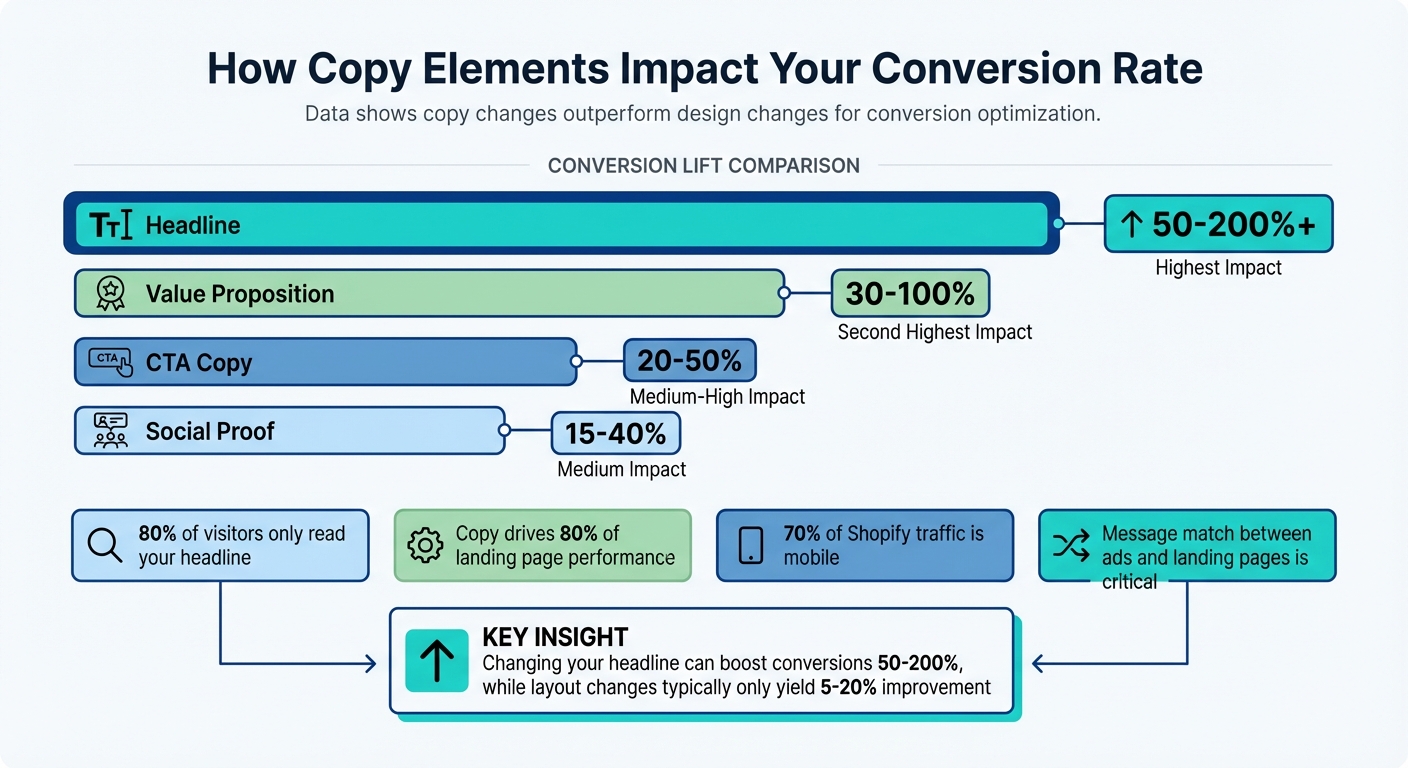
How Landing Page Copy Elements Impact Shopify Conversion Rates
How Copy Drives Conversions
When it comes to landing pages, copy is king - it drives a whopping 80% of the page's performance. Sure, design sets the stage, but it's the words that do the heavy lifting. In fact, tweaking just the headline can lead to conversion boosts of 50% to over 200%, while changes to layout typically result in a much smaller lift of 5% to 20%.
Think about what happens when someone lands on your page. They're silently asking: "Do you understand me? Can you solve my problem? Can I trust you?" If your copy doesn't answer these questions immediately, they won't stick around. Confusing or unclear messaging creates cognitive friction - a major reason why visitors leave without buying. If people don't understand how your product works or what action to take, you've lost them.
Another key factor is message match. If your landing page doesn't deliver on the promise made in your ad - whether that's solving a specific pain point or using consistent language - your conversion rate will take a hit. Your copy needs to seamlessly continue the conversation your ad started.
Here’s a breakdown of how key elements of copy can impact conversions:
| Copy Element | Expected Conversion Lift | Why It Matters |
|---|---|---|
| Headline | 50-200%+ | Grabs attention and determines if visitors stay in the first 3 seconds |
| Value Proposition | 30-100% | Explains why the visitor should act; if unclear, nothing else matters |
| CTA Copy | 20-50% | Drives the final action by reducing risk and emphasizing value |
| Social Proof | 15-40% | Builds trust, which is essential for converting hesitant buyers |
In short, strong copy doesn’t just convert - it builds trust and authority, setting the stage for long-term success.
Building Trust and Brand Authority
Great copy does more than sell - it makes your brand credible. While physical stores can rely on their atmosphere to build trust, online stores have to achieve the same effect with words. This is especially important when you consider that about 70% of online shopping carts are abandoned, often because customers lack confidence in areas like security, returns, or product quality.
To build trust, your copy needs to be specific. Avoid generic phrases like "high-quality" or "best-seller." Instead, use concrete details like "rated 4.9/5 by 3,200 happy customers" or "50,000 units sold in 2025". Specifics show transparency, which naturally earns trust.
Another way to establish trust is by simplifying technical details. For example, instead of saying "256-bit SSL encryption", try something more relatable: "Your payment info is protected by bank-level encryption. We’ll never store your card details." This approach speaks to both the logical and emotional concerns of your audience.
A great example of this is Dieux Skincare. In 2025, they introduced a "Sun-Screener" tool to help users analyze sunscreen ingredients and combat misinformation. Even though they weren’t selling sunscreen at the time, the tool positioned them as a trustworthy source for scientific education. Similarly, Grind, a London-based coffee company, uses its landing pages to highlight its sustainability efforts, like compostable packaging and ethical sourcing. By doing this, they stand out in a crowded market while building credibility.
Ultimately, your copy should do more than just sell - it should make visitors feel confident in choosing your brand.
Core Elements of High-Performing Landing Page Copy
Every part of your landing page works together to grab attention and guide visitors toward taking action. Now, let’s dive into the four key ingredients that help landing pages turn curiosity into conversions. Each plays a unique role in moving your audience closer to saying "yes."
Writing Headlines That Grab Attention
The headline is the first thing visitors see - and it’s make-or-break. With just seconds to hook someone before they leave, your headline needs to prove your page deserves their attention.
A great headline answers three key questions: What’s the product? Who’s it for? And why does it matter? Forget clever wordplay - clarity is what counts.
Focus on what your audience cares about: results. For instance, "Healthy smoothies anytime, without the kitchen mess" speaks to the customer’s desire for health and convenience. Compare that to a feature-heavy line like "USB-rechargeable 6-blade portable blender" - it’s clear which resonates more.
Here’s a simple formula to craft your headline: [Outcome] for [audience] without [pain/objection]. For example, "Professional copy in 30 seconds - no copywriter needed". Keep it short and snappy - 6 to 12 words is the sweet spot.
Don’t stop at one idea. Use A/B testing to try out two or three headline variations and see what clicks with your audience.
| Headline Type | Purpose | Example |
|---|---|---|
| Outcome-Driven | Highlights the result | "Sip. Save. Repeat." (Ghia) |
| Direct Action | Fulfills a need | "Underwear that absorbs your period" (Thinx) |
| Mission-Based | Reflects brand values | "Swim Happy" (Beefcake Swimwear) |
| Disruptive | Challenges the norm | "Break Free from Single-Use Bags" (LastObject) |
Creating Subheadlines That Show Benefits
While your headline grabs attention, your subheadline seals the deal. In just one or two sentences, it should expand on the promise of your headline and address specific frustrations.
For example, if the headline is "Get fit at home", the subheadline could say: "No gym membership, no commute. Just 20-minute workouts that fit your schedule." This makes the promise feel real and achievable.
Always focus on benefits, not just features. Instead of saying, "Our app has 500+ workouts", try, "Never get bored with fresh routines delivered every week."
Writing Clear and Persuasive Body Copy
Most visitors skim rather than read every word - about 20% of the text gets their attention. So, structure your copy to make scanning easy and decision-making fast.
Use a clear hierarchy with short paragraphs (2 to 4 sentences) and break up text with subheadings and bullet points. If you’re using bullet points, stick to 5–7 items and follow a "benefit + mechanism" approach. For example: "The 3-word subject line formula that increased open rates by 34%".
Start by listing three specific pain points your audience faces, using their own words to show you understand their struggles. Then, introduce a simple 3-step "How it Works" section. Keep each step title under five words and add a one-sentence explanation to make it crystal clear.
Don’t shy away from objections - tackle them head-on. Use an FAQ section to address the top 4–5 concerns, like "Does this work for my industry?" or "Can I get a refund?".
Once your body copy is polished, it’s time to focus on the final piece of the puzzle: the call-to-action.
Creating Effective Call-to-Actions (CTAs)
Your call-to-action (CTA) is where conversions happen - or don’t. The biggest mistake? Using generic, action-oriented phrases like "Submit" or "Buy." Instead, make your CTA value-focused. Tell the visitor exactly what they’ll get. For instance, "Get My Free Guide" is far more compelling than "Submit".
"CTA button text should describe the value received... not the action taken. 'Get My Free Guide' outperforms 'Submit.'"
Keep your CTA short - just 2 to 4 words - and use benefit-driven verbs like "Start", "Get", "Send", or "Join". To add urgency, include phrases like "Only 3 left!" or "Sale ends tonight."
Place your main CTA above the fold so it’s visible without scrolling. On longer pages, repeat it after each major section. Add microcopy near the button, such as "No credit card required" or "Unsubscribe anytime", to ease concerns and build trust.
| Weak CTA | Strong CTA | Why It Works |
|---|---|---|
| Submit | Get My Free Guide | Highlights what the visitor gains |
| Sign Up | Start My Free Trial | Emphasizes benefits over effort |
| Download | Send Me the Playbook | Creates anticipation |
| Register | Save My Seat | Conveys exclusivity |
Experiment with your CTA’s wording, color, and placement using A/B testing to find what drives the most clicks and conversions.
Proven Strategies for High-Converting Copy
Once your landing page has its basic structure, it’s time to fine-tune your copy. The goal? Address your shoppers’ real needs and make clicking "buy" irresistible.
Identifying Your Target Audience and Their Pain Points
Great copy starts with knowing your audience. The most effective landing pages speak directly to a person’s struggles - using their own language. How do you get there? Start by talking to your customers. Interview 5–10 of your happiest buyers, or send out a survey to at least 20 if interviews aren’t possible. Ask these four questions to uncover their motivations:
- Why did you buy our product?
- What alternatives did you consider?
- Where did you look for information?
- Why did you buy now?
These answers go beyond assumptions, revealing the real reasons people choose your product.
But don’t stop there. Dig through customer support emails, social media comments, and product reviews to find the exact words and phrases your audience uses. Your sales and support teams can also highlight recurring objections and challenges.
When you write your copy, use this language to show you truly understand their pain points. For example, instead of saying, "Our software saves time", say, "Tired of spending 3 hours every week manually updating spreadsheets?" This level of detail resonates because it mirrors their experience.
Once you’ve nailed down their challenges, you can use urgency to encourage action.
Using Urgency and Scarcity to Motivate Action
Building on what you’ve learned about your audience, urgency can push them to act faster. Time pressure and limited availability tap into our natural fear of missing out (a concept rooted in loss aversion, as explained by psychologist Daniel Kahneman). When done honestly, urgency and scarcity are powerful tools for increasing conversions. In fact, countdown timers alone have been shown to boost conversions by 8–32%. But it’s important to stay genuine - false urgency can quickly damage trust.
Here’s how to use urgency effectively:
- Time-based urgency: Highlight flash sales, shipping cutoffs, or limited-time discounts. For example, Bose ran a one-day flash sale offering $50 off QuietComfort 45 headphones exclusively to email subscribers. Their subject line - "1-day sale! $50 off our best-selling QC45" - created a clear deadline and drove immediate traffic.
- Scarcity tactics: Show inventory counts only when stock is low (e.g., fewer than 5–10 units). Messages like "Only 3 left in stock" can increase purchase intent by 22%. A memorable example? Kim Kardashian’s Fendi X SKIMS collaboration, which generated over $1 million in revenue within a minute, thanks to a limited-quantity strategy.
Strategically place timers and alerts where they’ll have the most impact. Use an announcement bar for sitewide promotions or position a timer near the "Add to Cart" button for product-specific urgency. For shipping deadlines, try copy like, "Order in 3 hrs to get it by Friday" to encourage impulse buys.
| Tactic | Avg Conversion Lift | Best For |
|---|---|---|
| Countdown Timer (sale) | 8–32% | Flash sales, general promotions |
| Shipping Deadline Timer | 12–25% | Seasonal/holiday shopping |
| Low Stock Alerts ("Only 3 left") | 10–22% | Limited inventory, unique items |
| Flash Sale | 25–35% | Clearing inventory, list engagement |
With urgency in place, let your customers’ voices seal the deal.
Adding Customer Testimonials and Social Proof
While urgency grabs attention, authentic customer validation builds trust. Shoppers often trust the experiences of others more than your own sales pitch. Including reviews can boost conversion rates by up to 270%, and products with reviews convert at 3.5 times the rate of those without them.
Position your best testimonial prominently - ideally above the fold near the hero section. Star ratings placed next to your call-to-action button can also reduce hesitation. Even just three well-placed testimonials can boost purchases by 34%.
Be specific with your social proof. Use exact numbers, like "11,247 customers", rather than vague claims such as "thousands." Specific figures enhance credibility. Interestingly, a mix of positive and negative reviews can appear more authentic and may even convert better than an all–5-star rating. For most Shopify categories, a star rating between 4.2 and 4.8 is ideal.
User-generated content, like customer photos and videos, is especially compelling. It’s five times more effective than professional product photos at influencing purchases. If you’re investing in premium social proof, prioritize video testimonials. They capture tone and body language, adding a layer of authenticity that’s hard to fake.
With these strategies in place, you’re well on your way to creating copy that not only grabs attention but also drives results.
Optimizing Your Copy for Better Performance
Your copy might be convincing, but if it's difficult to read or doesn't rank well in search results, it won't deliver results. Fine-tuning your content ensures it not only persuades but also performs effectively across devices and search engines. This difference can turn a casual visitor into a loyal customer.
Formatting Copy for Mobile and Desktop Users
With over 70% of Shopify traffic coming from mobile devices - and some stores seeing as much as 80% - your landing page must be mobile-first. Start with a single-column layout for mobile to keep text and images clear and legible. For desktop, you can expand to multi-column grids.
To make your content easy to scan, break it into short paragraphs, use subheadings every few sections, and include bulleted lists. A clear font hierarchy is essential:
- H1 headings: 32–48px
- H2 headings: 24–32px
- Body text: At least 16px
Leave 40%–50% whitespace to emphasize your CTAs. On desktop, ensure your headline, hero image, and main call-to-action are visible within the first 600 pixels. On mobile, these should appear immediately without scrolling.
For mobile usability, make buttons at least 44×44 pixels (ideally 48px) for easy tapping. Include a sticky "Add to Cart" bar that stays visible as users scroll, keeping your CTA accessible at all times.
Don’t forget page speed: compress images to under 300KB using modern formats like WebP. Each extra second of load time can cut conversions by 7%. Avoid autoplay videos on mobile, as they can slow down connections and frustrate users.
Once your copy is optimized for a seamless user experience, it’s time to test its performance.
A/B Testing to Improve Conversions
A/B testing helps you figure out what resonates with your audience by testing one element at a time - like a headline, CTA color, or social proof placement. Run tests for at least two weeks to capture both weekday and weekend shopping behaviors. Wait for statistical significance, with at least 1,000 visitors per variation, before making decisions.
Focus on high-impact elements like hero headlines, primary CTAs, and product images, as they can influence bounce rates within seconds. For instance, test whether an outcome-focused headline like "Healthy smoothies anytime" performs better than a feature-focused one like "6-blade portable blender". Try different CTA phrases, such as "Add to Basket" versus "Buy Now."
Analyze results separately for mobile and desktop. What works on one platform might not work on the other. Once you find a winning variation, implement it immediately and start testing a new idea to keep improving. While average landing page conversion rates hover around 6.6%, online stores typically see rates between 3% and 5%, with anything above 10% considered outstanding.
While testing fine-tunes your copy, ensuring it’s discoverable is equally crucial.
Adding SEO Keywords Without Sacrificing Quality
Your copy needs to rank in search results, but overloading it with keywords can ruin readability and alienate shoppers. Write for people first, then blend in keywords naturally.
Place your primary keyword strategically: in the first 100 words, at least one subheading, the H1 tag, and image alt text. Keep keyword density between 1%–2% to avoid penalties. Instead of repeating the same keyword, use semantic keywords (related terms) and long-tail keywords (specific phrases) to capture a broader audience without sounding repetitive.
Address the intent behind searches. For example, if someone searches "best eco yoga mats 2026", they’re comparing options - your collection page should provide a detailed comparison. If they search "buy cork yoga mat", they’re ready to purchase - your product page should make checkout effortless.
To improve rankings, write 150–300 words of unique copy for collection pages, targeting broad category keywords that individual product pages can’t. Add FAQ sections with schema markup to help Google display rich results and AI summaries. Keep title tags under 60 characters and meta descriptions under 155 characters to avoid truncation in search results. And never reuse manufacturer descriptions - unique content is non-negotiable for SEO success.
Working with Martin Monroe Creative for Professional Copywriting
If your landing page isn't converting as well as you'd like, professional copywriting could be the missing piece. Crafting high-converting landing page copy goes beyond just writing well - it’s about understanding e-commerce psychology, leveraging Shopify’s strengths, and shaping your brand’s story into something that inspires action. Whether you're struggling to refine your message or seeing disappointing conversion rates, professional copywriting can help turn things around.
Martin Monroe Creative's Services Overview
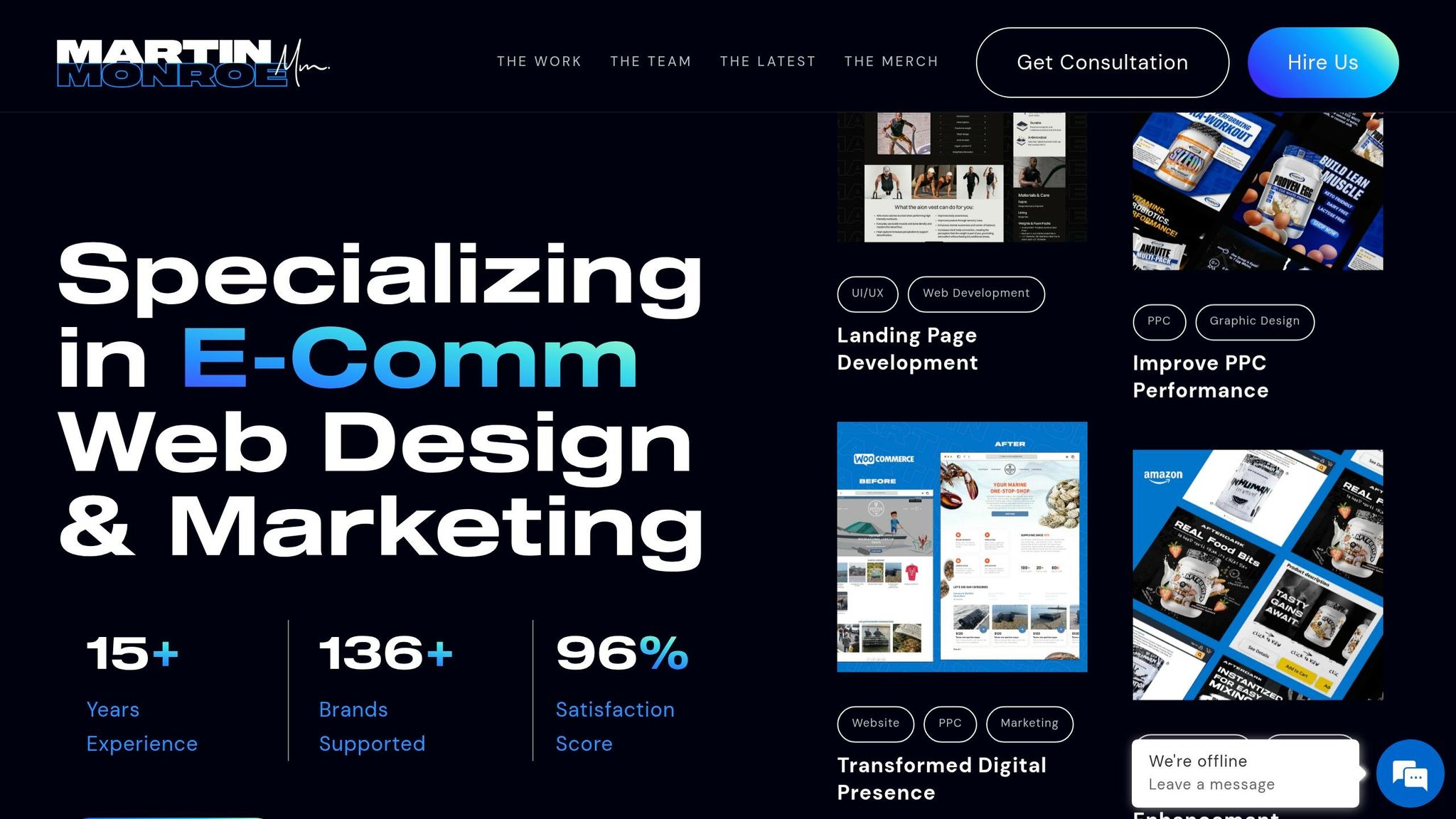
Martin Monroe Creative focuses exclusively on Shopify e-commerce, offering a range of services to elevate your brand. These include landing page development and expert copywriting, alongside UI/UX design, branding, PPC advertising, email marketing, and platform migration. They also assist with Amazon content updates and provide graphic design and logo creation to reinforce your brand identity across all channels. By integrating these services, they ensure your landing page copy aligns perfectly with your site’s design, ad campaigns, and broader marketing efforts.
Custom Solutions for Shopify Store Owners
Instead of relying on cookie-cutter templates, Martin Monroe Creative develops a detailed buyer persona tailored to your audience’s specific goals and pain points. This approach builds on the principles of clear and customer-focused messaging. They also customize copy to match the source of your traffic and incorporate the "voice of the customer" by analyzing reviews and social media feedback. This ensures your landing page feels like a natural extension of your audience’s journey and speaks directly to their needs. This personalized strategy helps create a landing page that’s primed for conversions.
Why Choose Martin Monroe Creative for Landing Page Copy
Martin Monroe Creative uses proven techniques - like clear value propositions, engaging storytelling, intuitive design, and ease of use - to boost conversions. They focus on eliminating confusion and friction by simplifying navigation, refining calls-to-action, and ensuring visuals are aligned with the message. They also leverage psychological triggers such as urgency and social proof, incorporating elements like media logos (“brag bars”) and user-generated content to instantly build trust. With their Shopify-specific expertise, they optimize copy for both mobile and desktop users while supporting your SEO objectives.
Conclusion: What You Need to Know About Shopify Landing Page Copy
Landing page copy has the power to transform visitors into paying customers. Think about it: improving your conversion rate from 2% to 5% means 150% more customers without increasing your ad spend. That’s why nailing your copy is one of the smartest ways to boost growth.
The numbers speak for themselves. To create effective landing pages, focus on the basics: match your copy to your ad, highlight the benefits, and stick to one clear goal. Keep your headline, value proposition, and main call-to-action above the fold (within the first 600 pixels). Since most visitors - over 70% - scan rather than read, format your copy so it’s easy to skim. Don’t forget social proof - testimonials and reviews can lift conversions by 34%. And tackle objections head-on with an FAQ section.
Use the PAS framework (Problem-Agitate-Solution), test one element at a time for two weeks, and always optimize for mobile users. Ongoing A/B testing can help fine-tune your message. Above all, prioritize clarity over persuasion - if visitors don’t understand your offer, they won’t convert. If your results still fall short, it might be time to bring in a professional copywriter.
Whether you’re crafting the copy yourself or working with experts like Martin Monroe Creative, the important thing is to take action. Every day you wait could mean lost revenue. Start refining your landing page copy today, and watch your conversions grow.