

Shopify merchants are turning to AI tools to deliver personalized shopping experiences, boost sales, and meet rising customer expectations. These tools analyze browsing habits, purchase behavior, and customer data to recommend products, improve search functionality, and increase conversions. Stores using AI personalization report higher average order values (AOV), better retention, and up to 31% of revenue driven by tailored recommendations.
Here are 8 top AI tools for Shopify personalization:
- Wizzy AI: Smarter search and discovery with typo corrections, image-based search, and swipeable browsing. Starts at $199/month.
- Klevu: AI-driven search and merchandising for large catalogs. Pricing starts at $649/month.
- LimeSpot: Real-time product recommendations and upsells with no-code setup. Offers a 15-day free trial.
- Octane AI: Personalized quizzes that refine recommendations and integrate with email marketing. Starts at $50/month.
- Rebuy: AI-powered upselling via "Smart Cart" and post-purchase recommendations. Pricing starts at $25/month.
- AiTrillion: Recommendation widgets like "Frequently Bought Together" with multi-channel integration. Freemium model available.
- Clerk.io: Behavioral data-driven bundling and cross-sells. Custom pricing.
- Shopify Magic: Free tool for generating product descriptions and review summaries.
These tools cater to different business sizes and needs, from improving search to driving upsells. Start small, focus on one area (e.g., cart abandonment or product discovery), and track metrics like conversion rates and average order value to measure success.
Quick Comparison:
| Tool | Key Feature | Starting Price | Best For |
|---|---|---|---|
| Wizzy AI | Advanced search and discovery | $199/month | Large catalogs needing smarter search |
| Klevu | Search and merchandising | $649/month | Enterprises with extensive product catalogs |
| LimeSpot | Real-time recommendations | Free trial | Small to mid-sized businesses |
| Octane AI | Personalized quizzes | $50/month | Growing customer profiles and email lists |
| Rebuy | Smart Cart and upselling | $25/month | Boosting AOV |
| AiTrillion | Multi-channel recommendations | Freemium | Cost-conscious merchants |
| Clerk.io | Behavioral data for bundling | Custom pricing | Cross-sell strategies |
| Shopify Magic | Content generation | Free | Content improvements |
Personalization is no longer optional. With 91% of shoppers preferring tailored experiences, AI tools help Shopify stores stay competitive and drive better results.
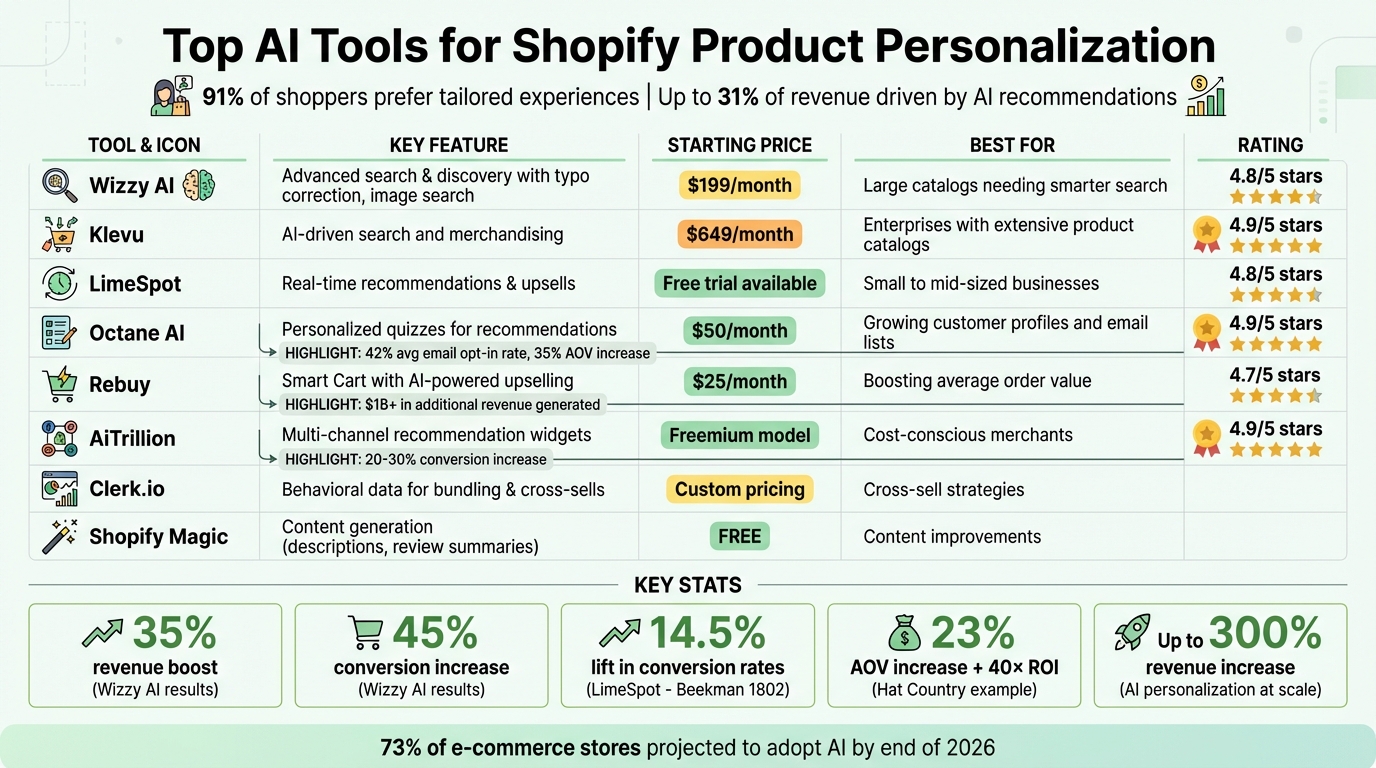
AI Tools for Shopify Product Personalization: Features and Pricing Comparison
Top AI Tools for Shopify Product Personalization

Here’s a rundown of some of the best AI tools to personalize your Shopify store. These tools offer a variety of features, from smarter search capabilities to interactive quizzes and dynamic upselling, all aimed at improving the shopping experience and boosting conversions.
1. Wizzy AI
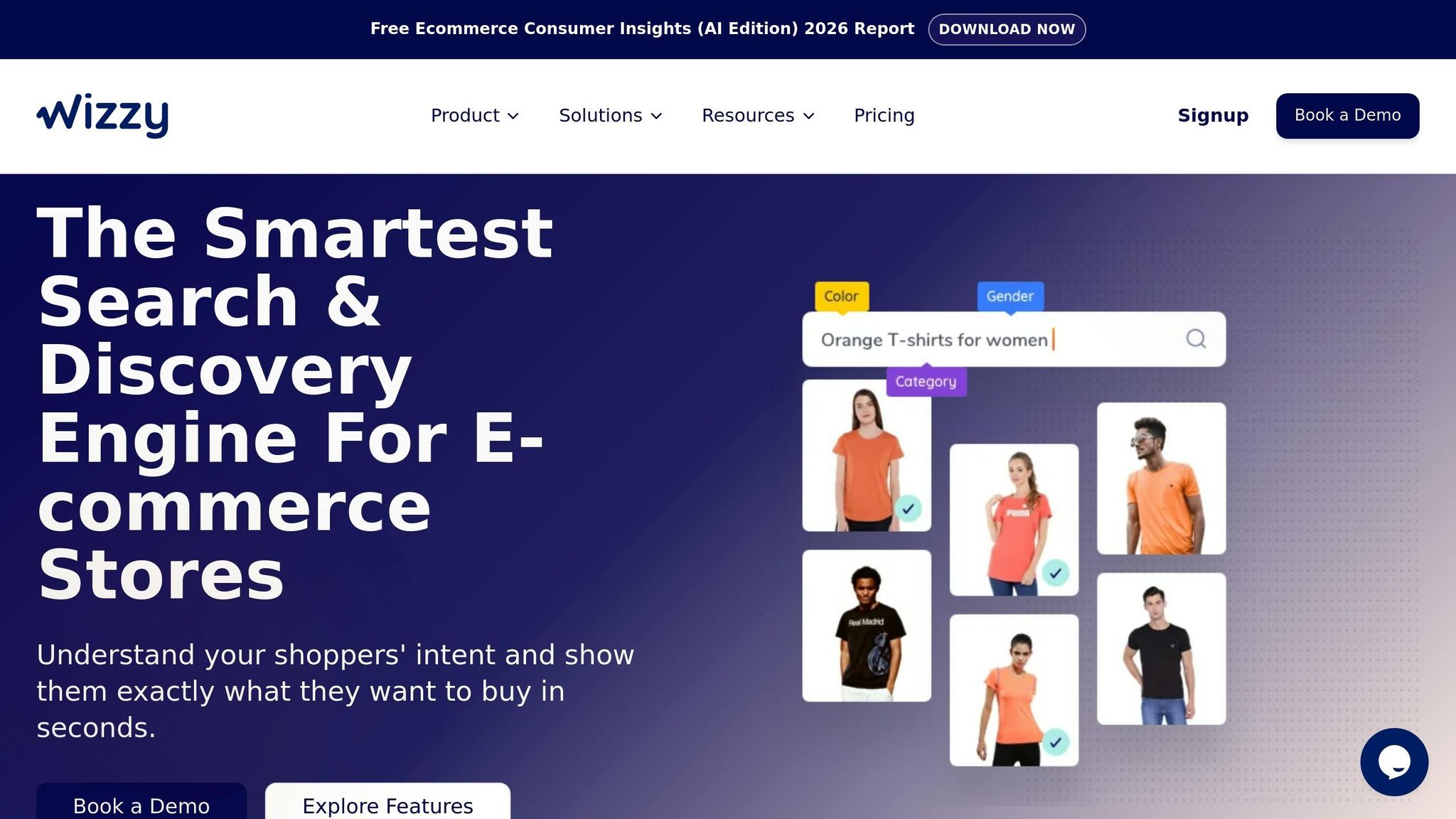
Wizzy AI is all about smarter search and product discovery. Using natural language processing, it ensures customers find exactly what they’re looking for - even if they make typos or need auto-corrections. It also offers a visual search feature, where shoppers can upload images to locate similar products, along with a "Reels View" for swipeable browsing. Stores using Wizzy often see a 35% revenue boost and a 45% increase in conversions. Pricing starts at $199/month for up to 25,000 products and 100,000 search queries. The tool enjoys a 4.8/5 rating on the Shopify App Store.
2. Klevu
Klevu specializes in AI-driven search and merchandising, making it a great choice for stores with extensive catalogs. Its natural language processing predicts shopper intent, while advanced filtering on product pages ensures a seamless browsing experience. Klevu is also compatible with Shopify Markets and headless storefronts using Hydrogen. Pricing begins at $649/month for site search and $449/month for its recommendation engine. It holds a 4.9/5 rating from 13 reviews.
3. LimeSpot
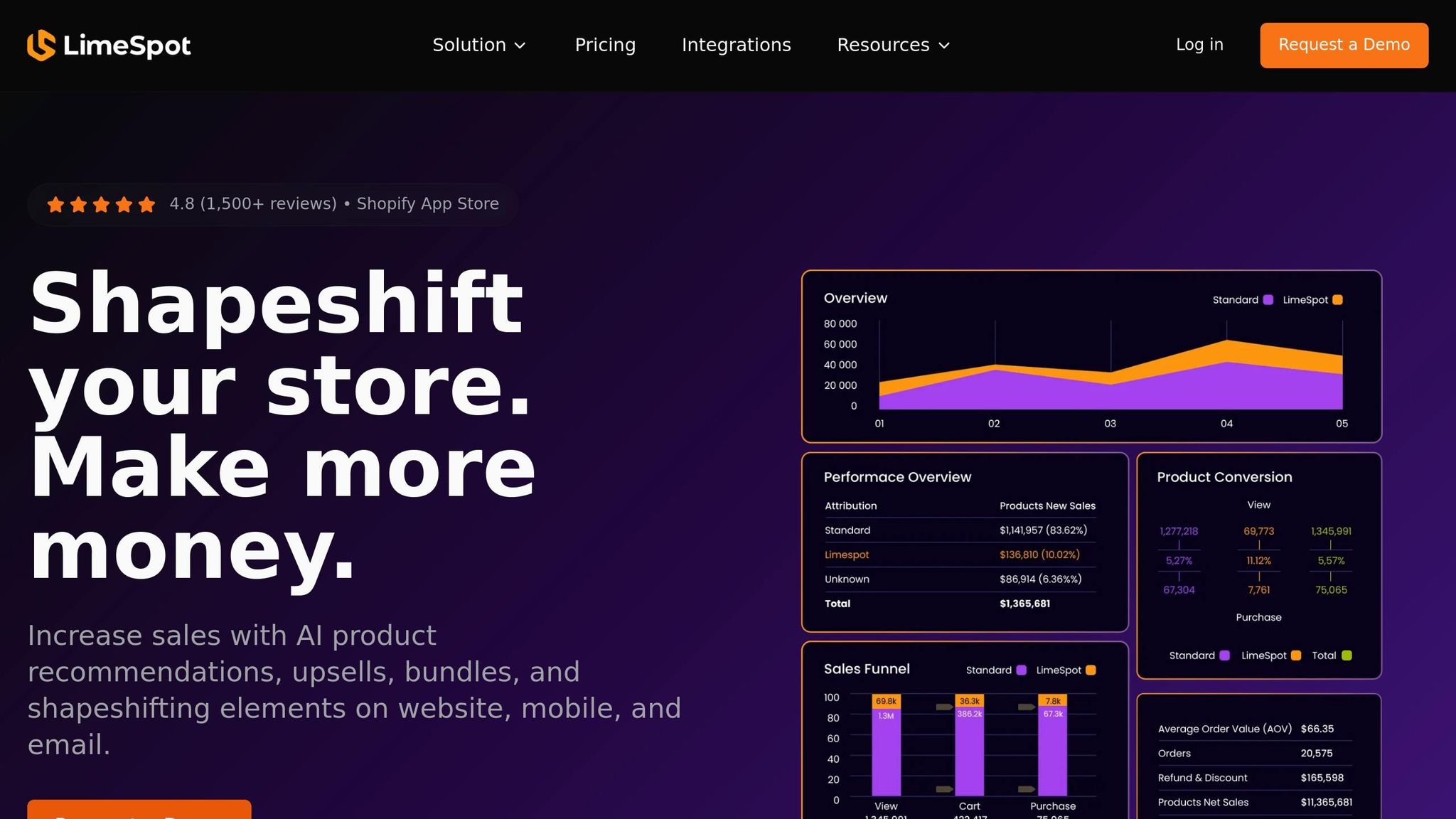
LimeSpot dynamically adapts store elements in real time based on customer behavior. This means everything from product recommendations to upsells and cross-sells adjusts as shoppers browse or add items to their cart. The platform offers a no-code setup, making it easy to deploy features across product pages, emails, and even ads.
LimeSpot offers a 15-day free trial with no setup fees and has a 4.8/5 rating from over 1,500 reviews.
4. Octane AI
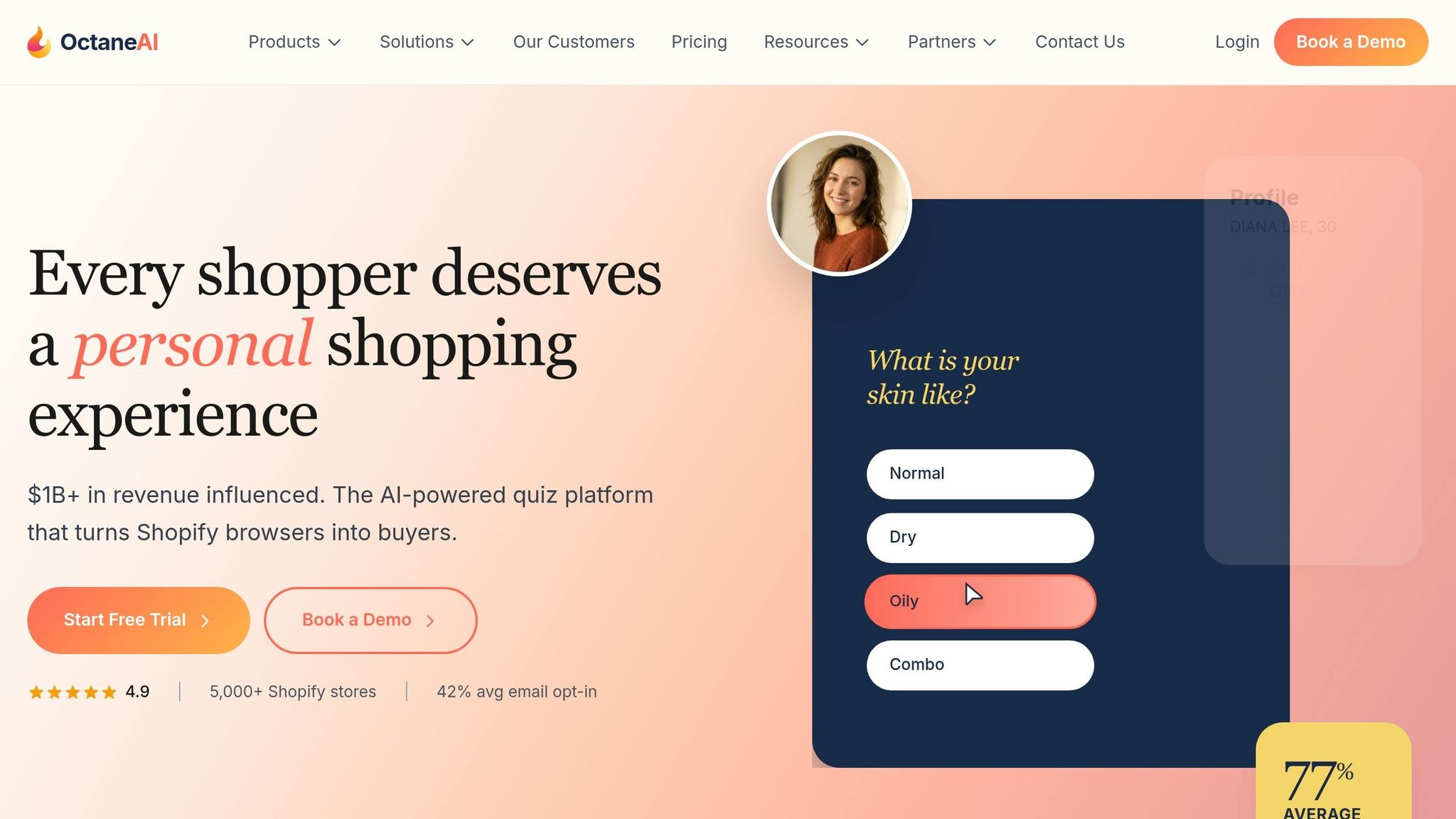
Octane AI focuses on personalized quizzes to gather zero-party data about customer preferences. Its CORE-1 AI engine uses quiz responses to refine product recommendations over time. The platform integrates seamlessly with Klaviyo for email marketing and Shopify Plus for checkout customization. Quizzes can even serve as ad landing pages, as demonstrated by Jones Road Beauty, which generated over $100 million in revenue and captured 800,000 subscribers using Octane AI.
Octane delivers an average email opt-in rate of 42% and a 35% increase in Average Order Value. Pricing starts at $50/month for 400 credits, and it has a 4.9/5 rating from over 5,000 Shopify stores.
5. Rebuy Personalization Engine
Rebuy’s standout feature is its "Smart Cart", which uses AI to suggest upsells and includes tiered progress bars to encourage larger purchases. It also offers post-purchase upsells and integrates with Klaviyo and Recharge for email flows and subscription upgrades. DIME Beauty saw an 11% increase in Average Order Value after using Rebuy’s recommendation widgets.
Rebuy has driven over $1 billion in additional revenue for Shopify brands. Pricing starts at $25/month based on order volume, and it has a 4.7/5 rating from 807 reviews.
6. AiTrillion AI Product Recommendations
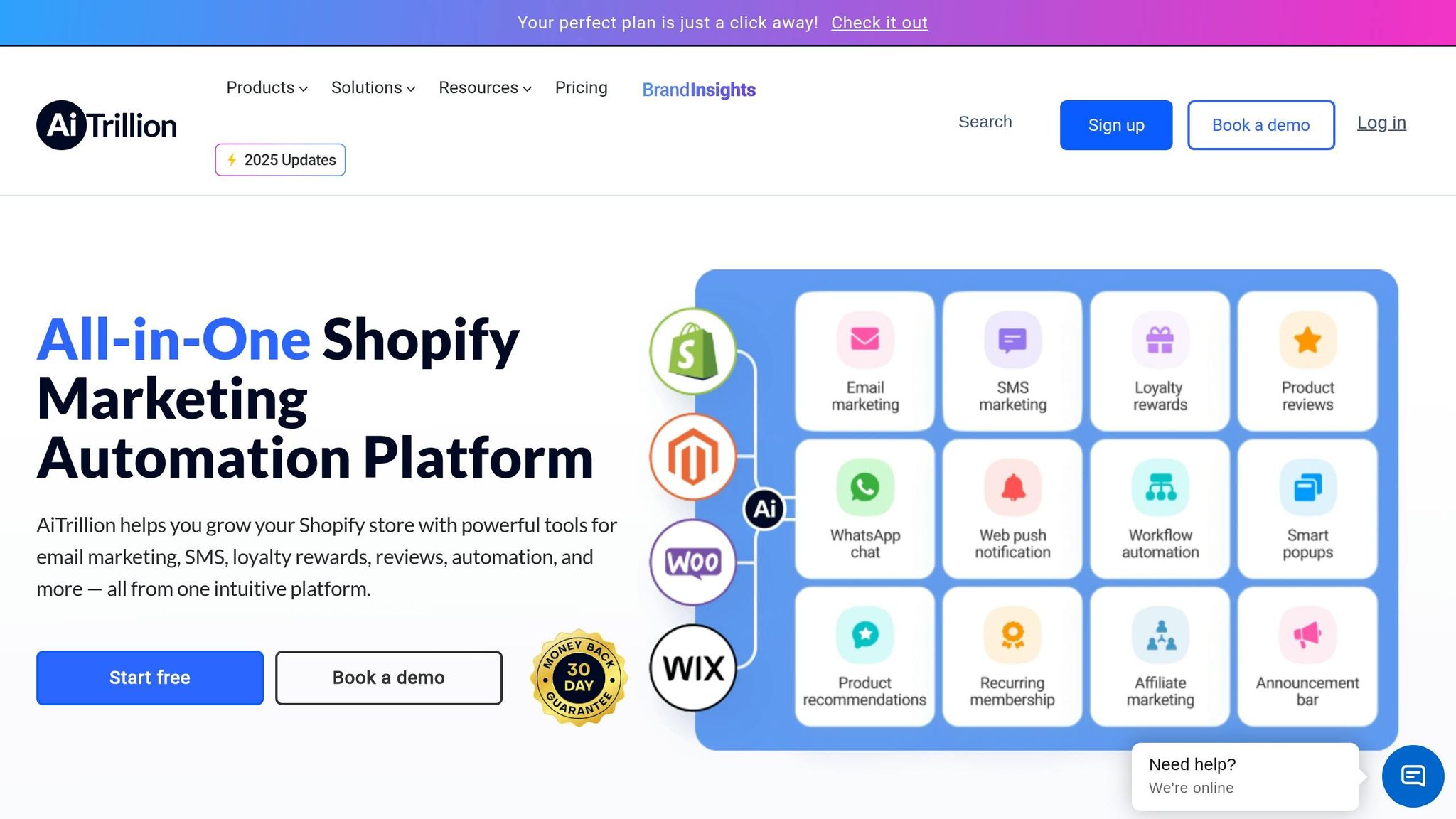
AiTrillion, formerly known as Wiser, offers automated recommendation widgets like "Frequently Bought Together" and "Inspired by Browsing." It integrates recommendations into emails, newsletters, and alerts, ensuring a consistent shopping experience across channels. Shopify stores using AiTrillion report a 20–30% increase in conversions.
AiTrillion has a 4.9/5 rating from 400 reviews.
7. Clerk.io
Clerk.io focuses on increasing average order value through behavioral data. It suggests complementary products at key moments in the shopping journey, making it ideal for optimizing product bundling and cross-sell strategies. The tool integrates directly with Shopify’s product catalog and customer data, streamlining the process.
8. Shopify Magic

Shopify Magic is an AI feature built directly into the Shopify platform. It helps merchants generate personalized product descriptions and summarize reviews to improve product discovery. While it doesn’t offer standalone recommendation widgets, it works well alongside third-party apps to elevate content quality. Shopify Magic is free for Shopify merchants, making it a handy addition to other personalization tools.
sbb-itb-8b1a57a
Comparison Table of AI Tools for Shopify
Comparison Table
When you're picking an AI personalization tool for your Shopify store, it's important to weigh the features, integration methods, pricing, and the kind of businesses each tool is best suited for. Here's a breakdown to help guide your decision:
| Tool | Key Personalization Feature | Shopify Integration | Pricing Model | Best For |
|---|---|---|---|---|
| Wizzy AI | Advanced product discovery and search optimization | Native app with catalog sync | Tiered pricing | Merchants with large catalogs seeking better search functionality |
| Klevu | Enhanced search and merchandising | Deep integration with the Shopify storefront | Tiered feature-based pricing | Enterprises managing extensive product catalogs |
| LimeSpot | Real-time dynamic personalization across channels | Seamless integration with Shopify catalog | Freemium with usage-based options | Small to mid-sized businesses looking for fast ROI |
| Octane AI | Interactive quizzes and personalized customer engagement | Works with Shopify and email marketing tools | Tiered pricing | Brands focused on growing customer profiles and email lists |
| Rebuy | AI-powered product recommendations and upselling | Direct integration with store data | Usage-based pricing | Merchants aiming to boost average order value |
| AiTrillion | AI-driven product recommendation engine | Multi-channel integration | Freemium with tiered plans | Cost-conscious merchants |
| Clerk.io | Personalization through behavioral data analysis | Integrated with Shopify product catalog | Custom pricing | Merchants focusing on product bundling strategies |
| Shopify Magic | Automated generation of product descriptions and review summaries | Native Shopify feature | Free | Merchants seeking content improvements at no additional cost |
AI tools for Shopify typically fall into three pricing categories:
- Free or native options: Tools like Shopify Magic, which enhance content without added expense.
- Tiered feature-based plans: Examples include AiTrillion and Octane AI, offering scalable pricing based on features.
- Usage-based models: Tools like LimeSpot and Rebuy, where costs depend on order volume or revenue.
For smaller businesses, tools like Shopify Magic, LimeSpot, and AiTrillion provide affordable solutions to help automate and personalize without a high upfront cost. Larger enterprises, on the other hand, might benefit from tools like Klevu or Rebuy, which offer advanced search and personalization capabilities tailored to complex needs.
Use this comparison as a starting point to evaluate which tool aligns best with your store's goals and scale. Up next, explore how to implement these tools effectively for your unique business needs.
Implementation Tips for AI Personalization on Shopify
Assess Your Store's Needs
Before diving into AI tools, start by organizing your product catalog. AI recommendation systems thrive on well-structured data, such as attributes like material, size, or compatibility. If your metadata is incomplete or inconsistent, the recommendations can feel random and miss the mark entirely. Make sure your products are properly tagged, grouped into collections, and include clear attributes before enabling personalization features.
Next, identify the pain points in your customer journey. Are shoppers struggling to find products through search? Are they leaving items in their cart without completing the purchase? Focus on the areas with the biggest impact. For instance, if cart abandonment is your main challenge, prioritize cart-related upsell features instead of attempting to personalize your entire site all at once.
When choosing an AI tool, consider your store's scale and traffic. Smaller stores might find basic tools sufficient, while mid-sized stores with annual revenues between $1 million and $5 million should explore more advanced platforms.
Test and Monitor Performance
Once your store's structure is ready, it's time to test and measure. Start by setting clear goals and evaluating the tool's performance against them.
One effective method is to use a holdout group, where 10% to 20% of your visitors experience a non-personalized version of your site. This control group provides a baseline to measure the impact of personalization on key metrics like Revenue Per Visitor (RPV). Without this comparison, it’s hard to know if the AI tool is truly making a difference.
Pay attention to the metrics that matter most:
- Click-Through Rate (CTR): Measures if recommendations are catching attention.
- Conversion Rate: Tracks how many clicks lead to actual purchases.
- Average Order Value (AOV): Indicates whether the AI is encouraging larger purchases.
Among these, RPV is the most comprehensive metric. Compare personalized sessions to non-personalized ones to gauge your return on investment.
Start small - focus on one placement, one hypothesis, and one metric. Override AI recommendations when necessary, such as during seasonal promotions, for high-margin products, or when launching something new. For visitors or products lacking purchase history, set up fallback options like best-sellers or manually tagged "new arrivals" to keep recommendations relevant.
Conclusion
A well-chosen AI personalization tool can turn your Shopify store into a highly responsive and customized shopping destination. By addressing the "discovery gap" - helping customers find what they want in just a few clicks - these tools redefine how shoppers engage with your brand.
The results speak for themselves. Businesses leveraging AI personalization at scale have reported revenue increases of up to 300% and boosts in average order value ranging from 10–25%. This is largely driven by the 91% of consumers who prefer shopping with brands that offer tailored recommendations and relevant deals. Real-world examples back this up.
It's important to align your tool selection with your specific business challenges. For example, if cart abandonment is a major issue, tools like Rebuy that focus on cart-level upsells could be a game-changer. On the other hand, if your store struggles with product discovery, search and recommendation engines like LimeSpot may be the better choice. Start small - perhaps with a high-impact area like your product page or cart - and track the results before scaling across your site.
With 73% of e-commerce stores projected to adopt AI by the end of 2026], personalization is no longer just an option - it’s become a core strategy for Shopify success. AI tools are now more accessible than ever, deliver measurable ROI, and can be implemented in manageable phases. By refining your product catalog, selecting the right tool for your needs, and addressing key pain points, you can begin transforming your store's shopping experience today.
FAQs
Which AI tool should I start with for my Shopify store?
Begin by selecting an AI personalization tool that matches your store's specific needs. For example, LimeSpot provides advanced product recommendations and tracks customer behavior, making it a powerful choice for tailoring shopping experiences. On the other hand, Wiser focuses on scalable upsell and cross-sell options, helping you boost sales through smart suggestions. Both tools are excellent picks for Shopify stores in 2026 - just choose the one that aligns best with your business goals and the shopping experience you want to deliver.
What data do these tools need to personalize recommendations?
AI tools designed for Shopify product personalization work by analyzing a mix of customer data and product information. Here's how it breaks down:
- Customer Data: These tools track browsing behavior, purchase history, products viewed, on-site searches, and even high-intent actions like clicking on size guides. This data helps build a clearer picture of what each customer is looking for.
- Product Catalog Information: They also pull in details from your product catalog, including categories, attributes, and other specifics. This ensures recommendations align with the available inventory.
By combining these data points, AI algorithms can "learn" customer preferences and deliver tailored product suggestions. The result? Higher conversion rates and increased average order values.
How do I prove personalization is increasing revenue?
To show how personalization can affect revenue, focus on tracking key metrics like conversion rates, average order value (AOV), and customer engagement. By comparing these numbers - along with total revenue - before and after using AI-driven personalization tools, you can clearly see where improvements have occurred.