

Subscription pricing can transform one-time buyers into loyal, recurring customers. Shopify stores using subscription models see up to 5–7x higher customer lifetime value and predictable revenue streams. With the subscription e-commerce market projected to reach $3.4 trillion by 2029, choosing the right pricing strategy is critical.
Here are five key subscription pricing strategies tailored for Shopify stores:
- Tiered Pricing: Offer multiple pricing levels (e.g., Basic, Standard, Premium) to cater to different budgets and encourage upsells.
- Usage-Based Pricing: Charge customers based on their actual usage, ideal for products with fluctuating demand.
- Hybrid Pricing: Combine a fixed base fee with variable usage-based charges for flexibility and steady revenue.
- Commitment-Based Pricing: Provide discounts for customers who prepay for longer subscription periods, such as 6 or 12 months.
- Value-Added Bundling: Package complementary products into a single subscription to increase average order value.
Each strategy has its unique benefits and challenges, from improving customer retention to boosting cash flow. Shopify's tools and apps like Recharge, Bold, and Skio make implementing these models seamless.
Quick Comparison Table:
| Strategy | Best For | Key Benefit | Challenge |
|---|---|---|---|
| Tiered Pricing | Broad customer segments | Increases upsells | Requires careful pricing structure |
| Usage-Based Pricing | Fluctuating usage patterns | Builds customer trust | Less predictable revenue |
| Hybrid Pricing | Balancing fixed and variable costs | Combines stability & growth | Complex to implement |
| Commitment-Based | Predictable revenue needs | Boosts upfront cash flow | May deter short-term buyers |
| Value-Added Bundling | Complementary products | Raises average order value | Demands effective inventory management |
Selecting the right strategy depends on your product type and business goals. For example, consumables like coffee thrive on commitment-based models, while discovery-focused products like beauty kits benefit from bundling. Even small pricing tweaks can yield significant profit gains - just a 1% price improvement can increase operating profit by 11.1%.
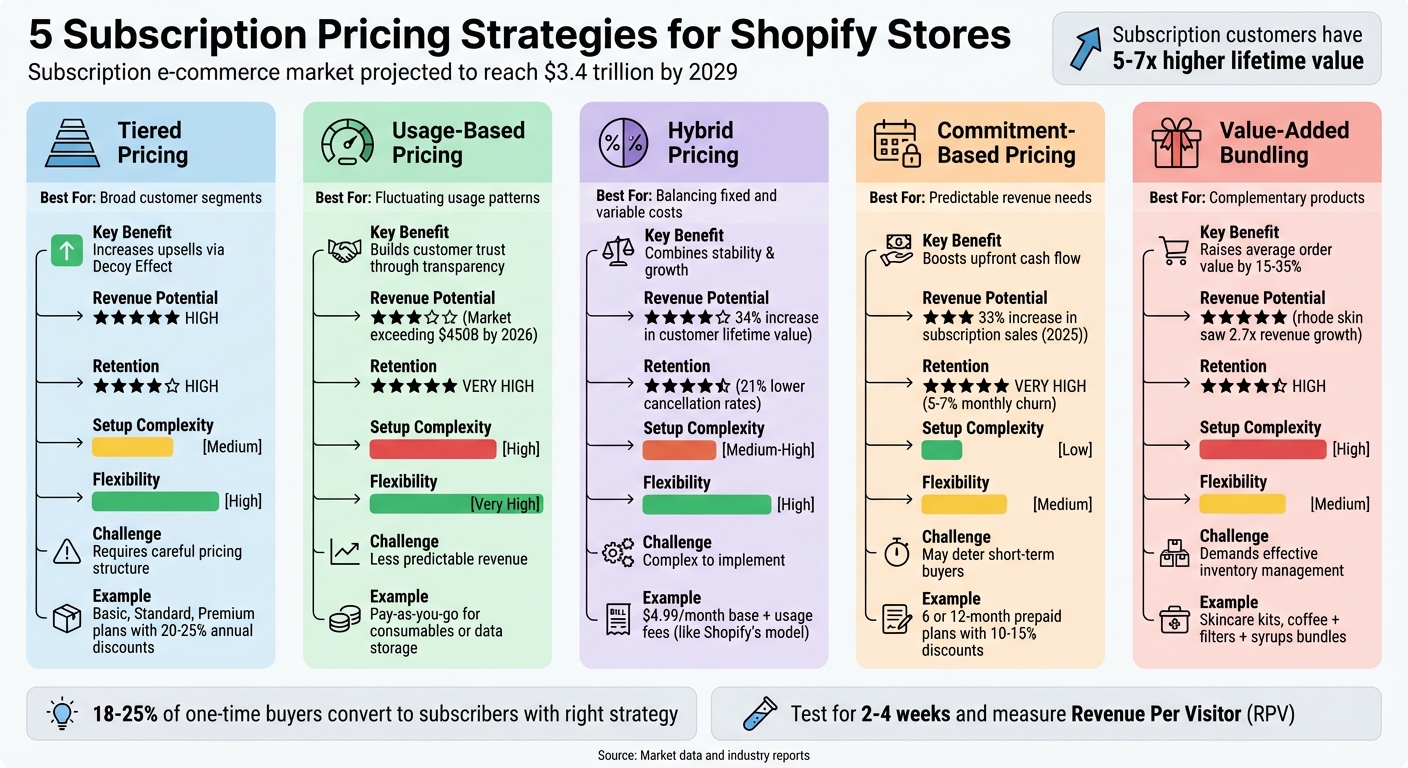
5 Subscription Pricing Strategies for Shopify Stores Comparison Chart
1. Tiered Pricing
Tiered pricing gives customers clear options - like Basic, Standard, and Premium - that cater to different needs and budgets. It cleverly uses the Decoy Effect to make the premium plan feel like the best value option. By simplifying choices, it helps reduce decision fatigue while appealing to a broader audience.
Revenue Potential for Shopify Stores

Even small pricing adjustments can make a big impact. For instance, improving pricing by just 1% can increase operating profit by 11.1%. Tiered structures like "Buy 1, Buy 3, Buy 6" encourage bulk purchases, boosting average order value. Similarly, annual subscription plans often include discounts of 20% to 25% compared to monthly rates. This not only improves cash flow but also lowers churn rates. On the other hand, subscribe-and-save models typically offer 10% to 20% off, nudging customers toward recurring purchases instead of one-time buys.
Some stores also tap into customer segmentation by offering tailored pricing. For example, wholesale buyers, VIP members, or loyalty program participants might get exclusive deals, maximizing value from these specific groups.
Ease of Implementation on Shopify
While tiered pricing can drive revenue, its success depends on how well it's implemented. Shopify's built-in Discounts tool is a good starting point for basic quantity- or spend-based discounts. However, these discounts only show up at checkout, not on product pages. For more advanced setups, apps like BSS B2B Solution (rated 4.8/5 with over 900 reviews), Bold Custom Pricing, or Volume & Tiered Discounts by HulkApps are excellent choices. These tools integrate with Shopify's Selling Plan API, allowing businesses to display volume pricing tables on product pages and create customer-specific tiers. Customers can also use self-service portals to manage subscriptions, swap products, or adjust delivery schedules.
Flexibility for Diverse Customer Needs
Tiered pricing also shines in its ability to adapt to different customer preferences. For instance, frequency-based tiers let customers choose delivery schedules - monthly, quarterly, or bi-annually - offering better prices for longer commitments. This approach not only aligns costs with actual usage but also reduces churn. Customers are more likely to stick around when upgrades feel like a natural choice rather than a hard sell. By offering this flexibility, businesses can foster stronger relationships with their customers and encourage organic growth over time.
sbb-itb-8b1a57a
2. Usage-Based Pricing
Usage-based pricing, also known as pay-as-you-go, offers a flexible alternative for customers with changing consumption needs. Instead of a fixed monthly fee, this model charges based on actual usage - whether it's resources, products, or services. It’s particularly effective for consumable goods, data storage, or SaaS-style services where demand fluctuates from month to month.
Revenue Potential for Shopify Stores
The subscription eCommerce market is expected to exceed $450 billion globally by 2026. Usage-based pricing provides an easy entry point for customers, allowing them to start small and increase spending as their needs grow. Businesses with strong subscription elements often achieve valuation multiples 2–3x higher than those relying solely on one-time sales. While this model enables revenue to grow alongside customer engagement, it can result in less predictable monthly cash flow compared to fixed-rate subscriptions. However, its scalability often strengthens customer trust by aligning billing with actual usage.
Customer Retention and Loyalty Impact
This pricing approach fosters trust through transparency, helping customers avoid overpaying for unused features (commonly referred to as "shelfware"). Its flexibility can boost retention since customers are more likely to reduce spending during slower periods rather than cancel altogether. To avoid "bill shock", it's smart to offer tools like usage calculators or dashboards and allow customers to set monthly spending limits. These features can go a long way in maintaining trust and loyalty.
Ease of Implementation on Shopify
Implementing usage-based pricing on Shopify requires advanced billing tools. Apps like Recharge, Skio, or Appstle offer real-time metering capabilities, leveraging Shopify's Selling Plan APIs to track usage accurately. Transparent communication about how usage is calculated can help reduce billing-related churn. Tracking metrics such as Monthly Recurring Revenue (MRR) and Average Revenue Per User (ARPU) can also help you identify and optimize profitable usage levels.
Flexibility for Diverse Customer Needs
This model is perfect for businesses catering to unpredictable usage patterns, as it allows customers to pay only for what they use. For instance, education platforms might charge per lesson, fitness services per session, or professional services per hour of use. Start with a limited base tier to attract customers and gradually transition to full pay-as-you-go pricing. Close monitoring of usage data is essential for refining this strategy. By analyzing patterns, you can fine-tune pricing thresholds to better align with customer behavior.
3. Hybrid Pricing
Hybrid pricing combines the strengths of tiered and usage-based models by integrating fixed fees with variable charges. This approach typically includes a fixed monthly base fee alongside usage-based costs. For Shopify stores, this could mean offering a $4.99/month membership that provides perks like free shipping and exclusive discounts, or a base subscription supplemented by optional add-ons. Shopify itself uses this model, charging fixed monthly fees (ranging from $25 to $289) paired with transaction fees between 1.1% and 1.5% per sale.
Revenue Potential for Shopify Stores
This pricing strategy creates a steady revenue stream from fixed fees while allowing for additional earnings through usage-based charges. Businesses using hybrid models report a 34% increase in customer lifetime value compared to single-strategy pricing. By 2025, 73% of SaaS companies had adopted hybrid pricing, with 61% incorporating usage-based elements. The most effective models aim for a balance where 40–70% of revenue comes from fixed fees, while the rest scales with customer activity.
Customer Retention and Loyalty Impact
Hybrid pricing can help reduce churn by aligning costs with the value customers perceive. Instead of canceling their subscriptions, customers often adjust their usage to fit their budget. Flexible options, like pausing or skipping shipments, have been shown to lower cancellation rates by an average of 21%. Additionally, 68% of buyers favor flexible pricing over rigid plans. To maintain trust and avoid surprises, businesses can implement automated alerts when customers reach 50%, 75%, and 90% of their usage limits.
Ease of Implementation on Shopify
Setting up hybrid pricing on Shopify is straightforward, often taking just 1–3 days using apps like Recharge, Skio, or Bold, which integrate with the Selling Plan API. Start by defining your fixed component, such as a membership fee or base tier, and then add variable options like subscribe-and-save discounts (10–15% off) or usage-based add-ons. A customer portal can further enhance the experience, allowing subscribers to manage their plans, pause deliveries, or change order frequency. A well-crafted subscribe-and-save offer can convert 18–25% of one-time buyers into subscribers within their first year.
Flexibility for Diverse Customer Needs
Hybrid pricing appeals to a wide range of customers, from budget-conscious shoppers to growth-focused businesses. Those looking to save can stick to a low base tier, while businesses can scale up as their needs grow. The key is to use clear, easy-to-understand metrics, like the number of products delivered or transactions processed. If customers can’t explain your pricing in one sentence, it’s likely too complicated and should be simplified. For example, Shopify Email offers a simple structure: the first 10,000 emails each month are free, with a $1.00 charge for every additional 1,000 emails.
4. Commitment-Based Pricing
Commitment-based pricing involves customers agreeing to a set subscription period - usually 3, 6, or 12 months - in return for better rates or added benefits. Instead of paying monthly, customers prepay for multiple deliveries, which provides businesses with upfront cash flow and more predictable revenue. This approach is particularly effective for products like coffee, vitamins, or pet supplies, where routine replenishment is expected.
Revenue Potential for Shopify Stores
Prepaid subscriptions offer steady income, making it easier to manage inventory and predict sales trends. By providing quarterly or annual payment options at a discount - such as 15% off - businesses can secure upfront revenue while encouraging long-term customer commitment The subscription market is projected to grow to $3.4 trillion by 2029, and Shopify stores offering subscriptions saw a 33% increase in the first half of 2025 compared to the same period in 2024. Discounts of 10–15% on subscription plans compared to one-time purchases are usually enough to encourage customers to commit.
Customer Retention and Loyalty Impact
This pricing model helps reduce the cycle of one-time shoppers by fostering longer-term customer relationships. While average monthly churn for e-commerce subscriptions ranges from 5% to 7%, offering options like a 1–3 month pause instead of outright cancellation can lower churn by approximately 21%. For customers who attempt to cancel, presenting retention offers - such as discounts or free gifts - can win back 10–30% of these at-risk subscribers. Automated tools for handling failed payments, such as retrying expired credit cards, can recover an additional 10–20% of involuntary churn.
Ease of Implementation on Shopify
Shopify makes it simple to adopt commitment-based pricing using tools like the Subscriptions app or third-party solutions such as Recharge, Loop, or Bold. These integrate seamlessly with Shopify's Selling Plan API and offer no-code setups that can be operational in minutes. Businesses can configure pay-in-advance billing for multiple deliveries, assign eligible products, and create a self-service portal where customers can manage their subscriptions by skipping, pausing, or swapping products. Testing different billing cycles and offering flexibility within the portal helps reduce cancellations while maintaining steady revenue streams.
Flexibility for Diverse Customer Needs
Commitment-based pricing strikes a balance between predictable income and customer flexibility. For example, in November 2025, coffee brand Kloo, founded by Mariella Cho and Claudia Snoh, offered a subscription price of $25 per bottle (compared to $33 for a one-time purchase) with a two-bottle minimum to waive shipping fees. Meanwhile, Aerflo, a portable carbonation brand cofounded by John Thorp and Buzz Wiggins, introduced a model where refills are shipped only after customers return empty cartridges, reducing subscription fatigue by aligning shipments with actual usage. As John Thorp explained:
To us, a pure subscription - refills shipping every 30 days - lacks that extra step of anticipating a customer's problem before they have it.
Additionally, nearly 80% of Gen Z and millennial consumers say curated subscription boxes help them discover new products, further boosting the appeal of this pricing model.
5. Value-Added Bundling
After exploring flexible pricing and tailored subscription plans, value-added bundling emerges as another effective way to boost customer engagement and revenue. This strategy combines complementary products into a single subscription, creating a comprehensive solution for the customer. Think of a skincare bundle that includes a cleanser, toner, and moisturizer, or a coffee subscription featuring beans, filters, and syrups. The focus here isn’t just on discounts - it’s about offering an integrated solution that meets customer needs.
Revenue Potential for Shopify Stores
Bundling has proven to significantly increase both the average order value and long-term customer spending. Take the skincare brand rhode skin as an example: between January and July 2025, they shifted their focus to selling curated kits instead of individual products. This change resulted in their monthly revenue jumping from $948,000 to $2.53 million - an impressive 2.7x growth. Similarly, HiSmile, a teeth whitening retailer, introduced a bundle featuring over 10 toothpaste flavors. This led to 80% of their orders being bundled and a fourfold increase in average cart size. Even when discounts are factored in, bundling can boost order values by 15–35%.
Customer Retention and Loyalty Impact
Bundles do more than increase revenue - they help build customer loyalty. By offering a complete, recurring solution, such as a monthly skincare regimen or grooming kit, customers are less likely to cancel. These products are designed to work together seamlessly, creating a cohesive experience [30,31]. Bundling also reduces decision fatigue, simplifying the shopping process. Instead of choosing individual items, customers can trust the brand’s curated selection.
For instance, flower retailer Lvly expanded its Shopify Plus offerings to include over 150 bundled products in February 2023. This move contributed to their most successful Valentine’s Day sale ever, with a 6% year-over-year increase in average order value. Allowing customers to customize their bundles further enhances engagement and helps reduce cancellations. Bundling, like other pricing strategies, strengthens customer retention by making decisions easier and reinforcing the brand’s value.
Ease of Implementation on Shopify
Setting up value-added bundles on Shopify is straightforward. You can choose between fixed bundles with pre-selected items or flexible mix-and-match options. To manage subscriptions and bundling logic, Shopify offers tools that also keep inventory in sync [31,33]. A 10–20% discount on the total price of individual items is usually enough to incentivize purchases. However, deeper discounts might hurt profitability [36,37].
For example, Erica Werber, founder of Literie Candles, shared how they use bundling during the holidays:
"We've used it during the holidays for people to create their own gift box where they can have this fun user experience of selecting three candles... and then it just gets shipped off".
Stick to bundles with 2–5 items and display the original total price with a strikethrough to emphasize savings.
Flexibility for Diverse Customer Needs
Successful bundles strike a balance between expert curation and customer personalization. Fixed bundles are ideal for starter kits or routine sets, while mix-and-match options work better for products like snacks or coffee, where variety keeps things interesting. Tiered discounts - such as 10% off for 3 items, 15% off for 5, and 20% off for 7 or more - encourage customers to add more products while feeling they’re getting better value.
To build trust and minimize churn, send renewal alerts 3–7 days before charging. This gives customers the option to modify their bundle, skip a cycle, or pause their subscription. With 70% of shoppers now expecting AI-driven recommendations, tools that suggest dynamic bundles based on browsing history and past purchases are becoming the norm in 2026.
Pricing Strategy Comparison
When it comes to subscription pricing models, finding the right fit means weighing the pros and cons of each strategy. Your decision should align with your store's goals, the type of products you offer, and how much complexity your operations can handle. Here's a quick breakdown of the trade-offs to help you make an informed choice.
The table below highlights how the five pricing strategies compare across key factors that matter most to Shopify store owners:
| Strategy | Revenue Potential | Customer Retention | Setup Complexity | Flexibility |
|---|---|---|---|---|
| Tiered Pricing | High (via Decoy Effect) | High | Medium | High |
| Usage-Based | Moderate | Very High | High | Very High |
| Hybrid Pricing | High | High | Medium-High | High |
| Commitment-Based | High (Cash flow) | Very High | Low | Medium |
| Value-Added Bundling | High (AOV boost) | High | High | Medium |
Tiered Pricing uses psychological principles, like the Decoy Effect, to encourage customers to choose premium options. Usage-Based Pricing requires more advanced billing systems but excels in retention by tying costs directly to how customers use your product. Hybrid Pricing offers a mix of fixed and variable charges, giving you steady revenue while accommodating customer needs. Commitment-Based Pricing is the simplest to implement, thanks to built-in support in most Shopify apps, and it boosts cash flow with multi-period billing and discounts. Lastly, Value-Added Bundling increases average order value (AOV) but demands careful inventory management to deliver on its promise.
Ultimately, your choice hinges on what matters most to your business - whether that's boosting cash flow, ensuring customer loyalty, keeping things simple, or offering maximum flexibility. These priorities will shape the strategy you implement.
Conclusion
Selecting the right subscription pricing strategy depends on your business model and the type of product you offer. For consumable goods like coffee or supplements, replenishment models with subscribe-and-save discounts (typically 10–15%) can convert 18–25% of one-time buyers into loyal subscribers. In contrast, for discovery-focused categories like beauty or snacks, curated subscription boxes perform well when the perceived value is at least 1.3 times the subscription price. These strategies highlight how aligning pricing models with your products can directly impact both cash flow and customer retention.
Your business goals should drive your decision. If your priority is improving cash flow, commitment-based pricing - such as annual plans with 15–25% discounts - can provide upfront revenue. On the other hand, usage-based or hybrid models, which align costs with actual consumption, are better suited for boosting retention. Remember, subscription customers tend to have 5–7 times the lifetime value of one-time buyers, and even a small pricing adjustment of just 1% can increase operating profit by 11.1%.
For simpler implementation, tiered and commitment-based strategies can be executed using Shopify's built-in features. However, more complex models like usage-based pricing and value-added bundling may require advanced inventory and billing systems. To evaluate the effectiveness of your strategy, consider testing it for 2–4 weeks and measuring metrics like Revenue Per Visitor (RPV).
If you're looking for expert assistance, Martin Monroe Creative specializes in building Shopify subscription systems. Their team handles everything from checkout customization to advanced integrations, letting you focus on growing your recurring revenue while they manage the technical setup and ongoing optimizations.
FAQs
Which subscription pricing strategy fits my Shopify products best?
The right subscription pricing strategy hinges on your objectives, the type of product you offer, and your target audience. Popular approaches include:
- Replenishment: Ideal for products that customers use regularly, like vitamins or skincare items, ensuring they never run out.
- Curated Boxes: Perfect for delivering variety or an element of surprise, such as monthly snack packs or beauty kits.
- Memberships: Great for providing exclusive benefits, like premium content, discounts, or special access.
The key is to match your pricing model to what your customers value most. This not only boosts revenue but also strengthens customer loyalty - an essential factor as subscription-based e-commerce continues to thrive.
How can I test subscription pricing changes without reducing conversions?
To experiment with subscription pricing without scaring off potential customers, it's important to approach changes carefully and strategically. Start by running controlled tests that use realistic price ranges and only small, reasonable adjustments. This keeps the changes manageable and less likely to cause friction.
Use transparent testing methods, such as cohort testing (where different groups see different pricing) or tier testing (offering new pricing for specific subscription levels). These approaches help maintain customer trust while gathering useful data.
Take things slowly - roll out changes gradually and communicate updates clearly to your audience. Keep a close eye on critical metrics like churn rates and customer feedback to understand the impact of your adjustments. Tools like A/B testing can be invaluable for comparing customer reactions, and offering loyalty incentives can soften the blow of price changes while helping you gauge sentiment.
What metrics should I track to know my subscription pricing is working?
To fine-tune your subscription pricing, it's crucial to keep an eye on a few key metrics. Start with customer lifetime value (LTV) - for subscriptions, this is often 5–7 times greater than for one-time purchases, making it a critical factor in evaluating profitability. Another important metric is your churn rate, which tells you how many subscribers are canceling over time. Finally, look at the percentage of recurring revenue in your overall income. Together, these numbers give you a clearer picture of your subscription model's performance and help you make informed adjustments for sustained growth.